Digging deeper to find roots of Quad cherry trees
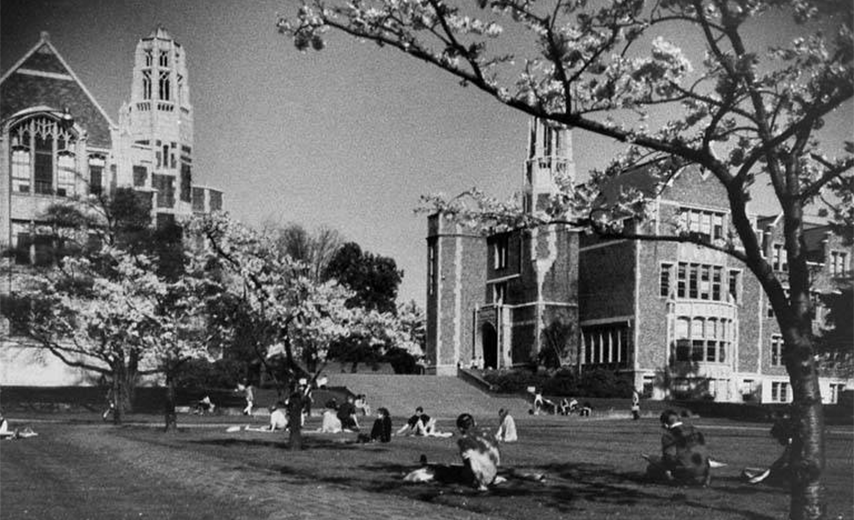
Students relaxing under the UW Quad cherry trees, sometime between 1964 and 1970. University of Washington Libraries, Special Collections, James O. Sneddon, photographer, UWC3127
Every year, thousands of people descend on the UW to view the Quad’s Yoshino cherry trees, most with camera in hand. Few University treasures are as well documented — but that’s only true since they were brought to campus. Their history before they got here is still up for debate.
The leading theory has been that the trees were purchased for the Washington Park Arboretum in 1939 and then transplanted to the Quad in 1962. But in 2017, Yuki Shiotani, a visiting student from Waseda University in Tokyo, debunked part of that story. His research proved that the trees came from the Arboretum in 1962, but there's no direct evidence for how they got there. Shiotani shared a theory that the trees were planted around 1936 by the Works Progress Administration as part of the New Deal.
Adding to the confusion, photographic evidence seems to show that the trees were younger when transplanted than the prevailing theories suggest, according to a 2025 story from The Daily.
It may be uncertain how the trees came to campus, but new research is working to chip away at the mystery. It goes beyond oral history and documentation, looking at the tree’s genes instead.
It’s like “Finding Your Roots: Cherry Tree Edition.”
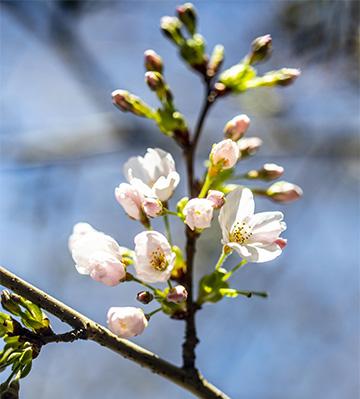
All Yoshino cherry trees are clones of a single tree that was propogated in the 1800s. Dennis Wise/University of Washington
Adam Steinbrenner, associate professor of biology, is a plant biologist who came to the UW in 2019. His first campus cherry tree season was in 2020 at the outset of the COVID-19 pandemic, when the Quad was closed to the public.
“My first experience of them was from afar but also as being really pristine at the same time,” he said. “Then I saw what a touchpoint they are for the community. The whole city comes to campus. It’s a great opportunity to connect with the community, especially about plants and biology.”
In 2024, a colleague of Steinbrenner, Alex Harkess at the HudsonAlpha Institute for Biotechnology in Huntsville, Alabama, reached out to him about a project he had started called the American Campus Tree Genomes (ACTG). The goal of the project is to use campus trees as a gateway for engaging students in genome sequencing, which is the process for determining an organism’s genetic makeup. For anyone who sends in leaves of campus trees, ACTG has the resources to help with the genome sequencing for that tree.
Steinbrenner saw this as a great opportunity to work with students, and he got a grant from the Campus Sustainability Fund for the Yoshino Genome Project. The grant provided funds for supplies and for hiring interns.
Four students, graduates Aiden Eno and Nandini Pathak and undergraduates Caitlin Dong and Preston Lam, under the guidance of graduate student Ben Sheppard, conducted the research last summer. They took leaves from three trees in front of Raitt Hall on the Quad’s northwest corner.
Yoshino cherry trees don’t produce fruit or seeds. They are propagated through cloning. Yoshinos are also a “very recent” clone, established in the 1800s, said Steinbrenner. This makes their lineage easy to trace.
“They're so similar to one another. It really comes down to something like 100 differences between all the Yoshino trees,” he said. “The only differences that have developed were presumably by random mutation, and those became signposts.”
Once Steinbrenner’s team had the trees’ genetic makeup, they took the genome from one tree and compared it against the genomes of 46 cherry trees back in Japan, some of which included the oldest cherry trees in the world. They found the tree’s closest relatives, tracking it back to three trees — one in Okayama, one in Tokyo and one in Matsue — that shared 85 percent of its mutations. They also used the data to create a lineage for the tree.

Yoshino Genome Project team standing in front of the tree whose genome was compared to those in Japan. L-R: Adam Steinbrenner, Caitlin Dong, Aiden Eno, Ben Sheppard, Preston Lam, Nandini Pathak (not pictured: Kelsey Wood). Yoshino Genome Project
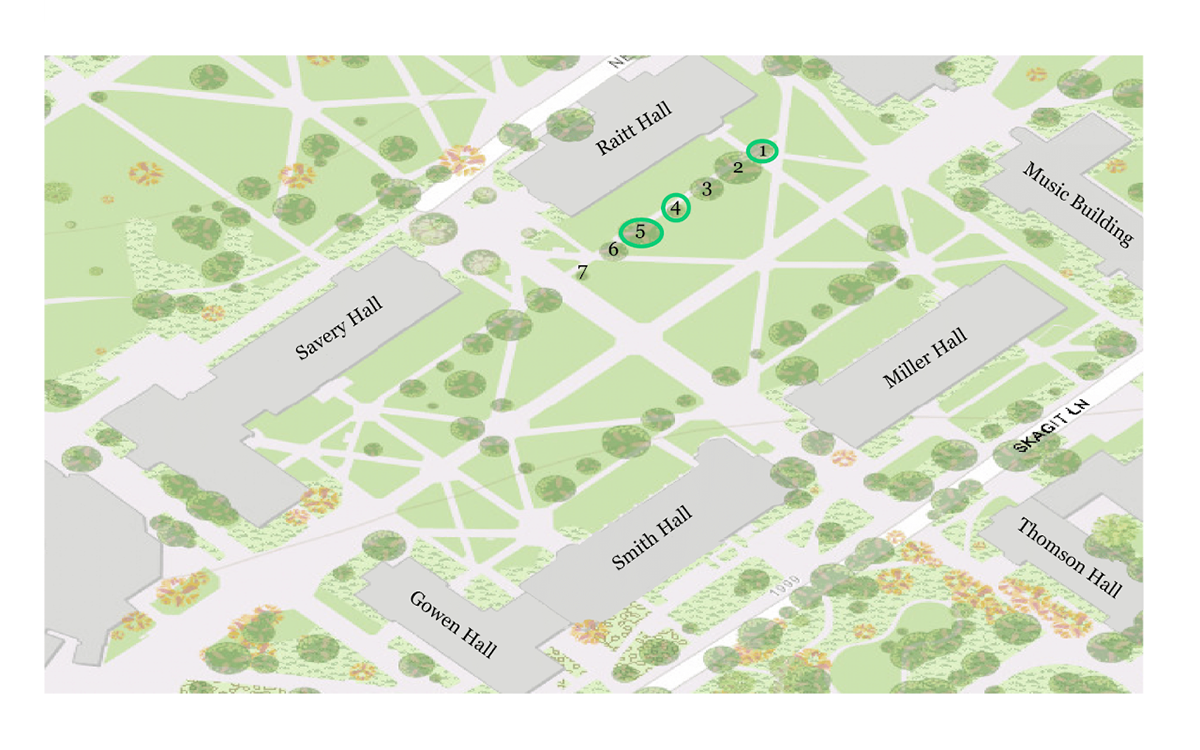
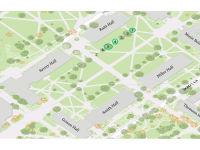
Map of the Quad with sampled trees circled. The genome of tree 1 was compared against those of 46 Japanese trees. Yoshino Genome Project
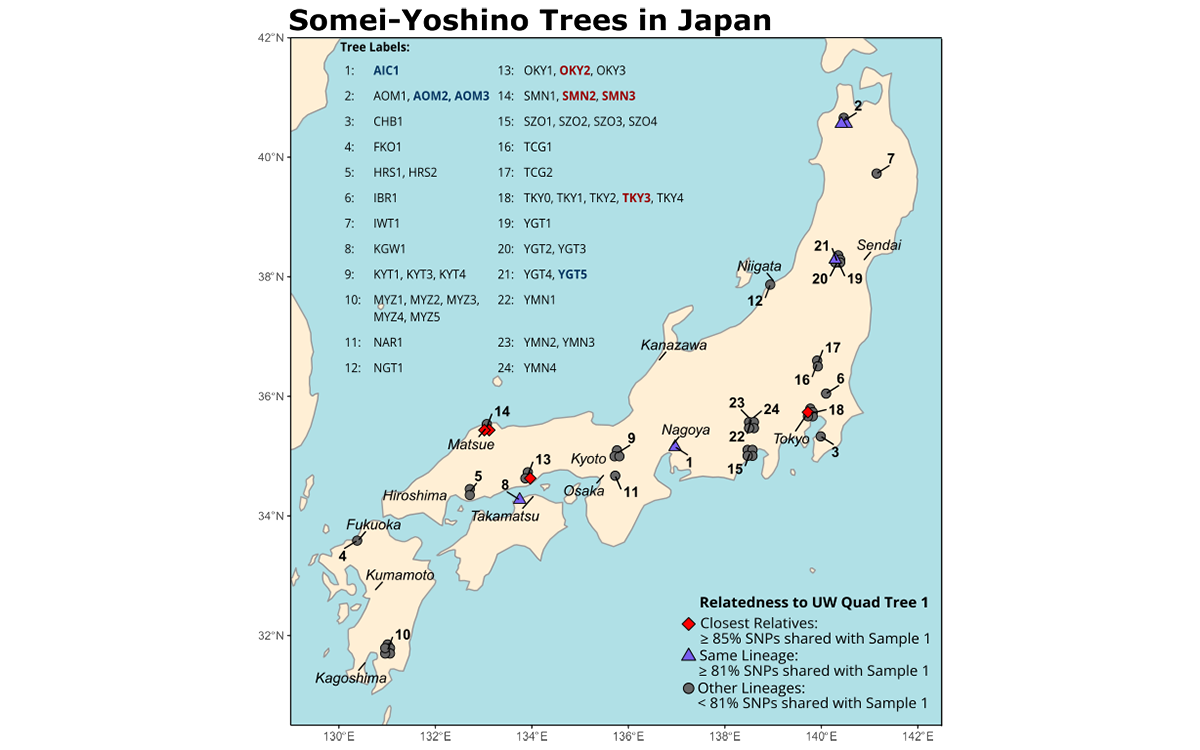
Map of Japan showing trees that the UW Quad cherry tree was compared to, with red triangles showing its closest relatives in Okayama, Matsue and Tokyo. Yoshino Genome Project

Representative model of genetic sequences from UW Quad cherry tree and the most closely related cherry trees in Okayama and Matsue. Yoshino Genome Project



Steinbrenner gives credit to the students, who divided up work on the project, including assembling and mapping the genome, generating the scientific figures and creating the project’s webpage. With a huge volume of data at their fingertips, they got hands-on experience in bioinformatics, a field that brings together biology and information science.
“I’m really interested in genetics,” said Aiden Eno, ‘25. “And as the field shifts towards larger and larger data, the skills this project required are becoming more and more valuable.”
All the students said working with the cherry trees was a bonus.
“I thought it was a project I would learn a lot from, but I also felt certain that I would enjoy it,” said Caitlin Dong, ‘28.
Along with the hands-on scientific work, the students still at the UW will help with tours and other education projects sharing their findings.
Mapping the genome of the Quad cherry trees doesn’t solve the mystery of their origin, but it provides a foundation for further discovery. Steinbrenner’s team can compare the tree to others, such as the cherry trees in Washington, D.C. once those are sequenced. They can also sequence more trees in the Quad, such as the ones that flower earliest and latest to see if that reveals anything interesting about their genetics.
Steinbrenner sees the project as a way for students and the community to engage with biology through a beloved campus resource.
“I think something about knowing the genome of something connects you to it. It feels like a little bit of a connection to heritage,” he said. “We know what, all the way down to their DNA, makes our trees special.”