Summertime is service time for UW Facilities
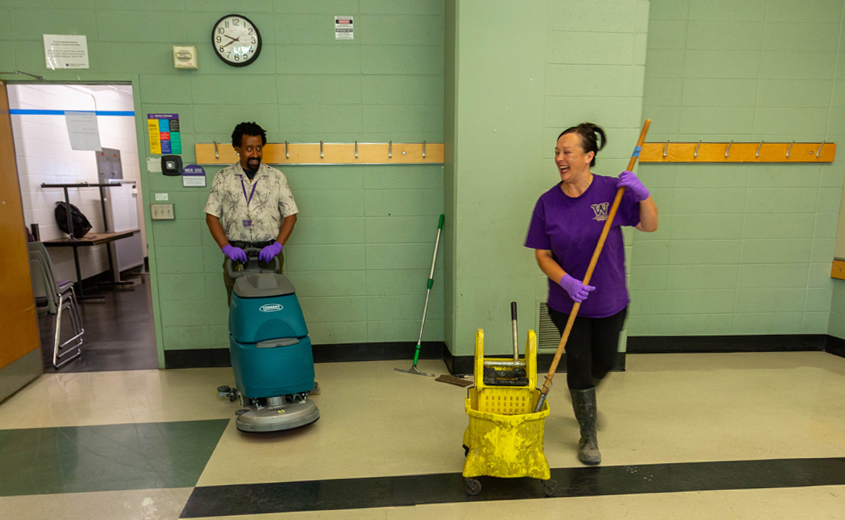
Custodians Angelina Quintero, right, and Yesake Mebratu share a laugh while cleaning a floor in the Mechanical Engineering Building. This kind of deep cleaning is one of many activities Facilities staff undertake each summer across campus. Misty Shock Rule/University of Washington
On a September morning, custodians Angelina Quintero and Yesake Mebratu guide their cleaning tools across a classroom floor in the Mechanical Engineering Building, part of a summertime deep clean of buildings. Across campus, other UW Facilities staff have spent the summer repairing parking facilities, installing new water fountains and rethinking cooling system maintenance.
While much of the UW community is away over the summer, it’s one of the busiest times for UW Facilities.
Taking advantage of an empty campus
Taking advantage of an empty campus
Summer is an ideal time for some annual maintenance tasks not just because campus is a little quieter — it’s also a little sunnier. That makes painting parking lots, for example, a lot easier.
Throughout the year, Transportation Services staff inspect campus parking lots to check if lines are clear and then prioritize which ones to repaint. This summer, the painting team has been restriping 31 lots, a task made easier thanks to a new paint that takes under 30 minutes to dry. Projects that took several days are now finished in a matter of hours, which is better for the customer, said Maintenance Manager Edwin Campbell.
On the Grounds team, gardeners focus on areas harder to access when campus is full of people. Summer projects include tree trimming and removal, work along pathways, removal of invasive weeds and jobs requiring loud power equipment.
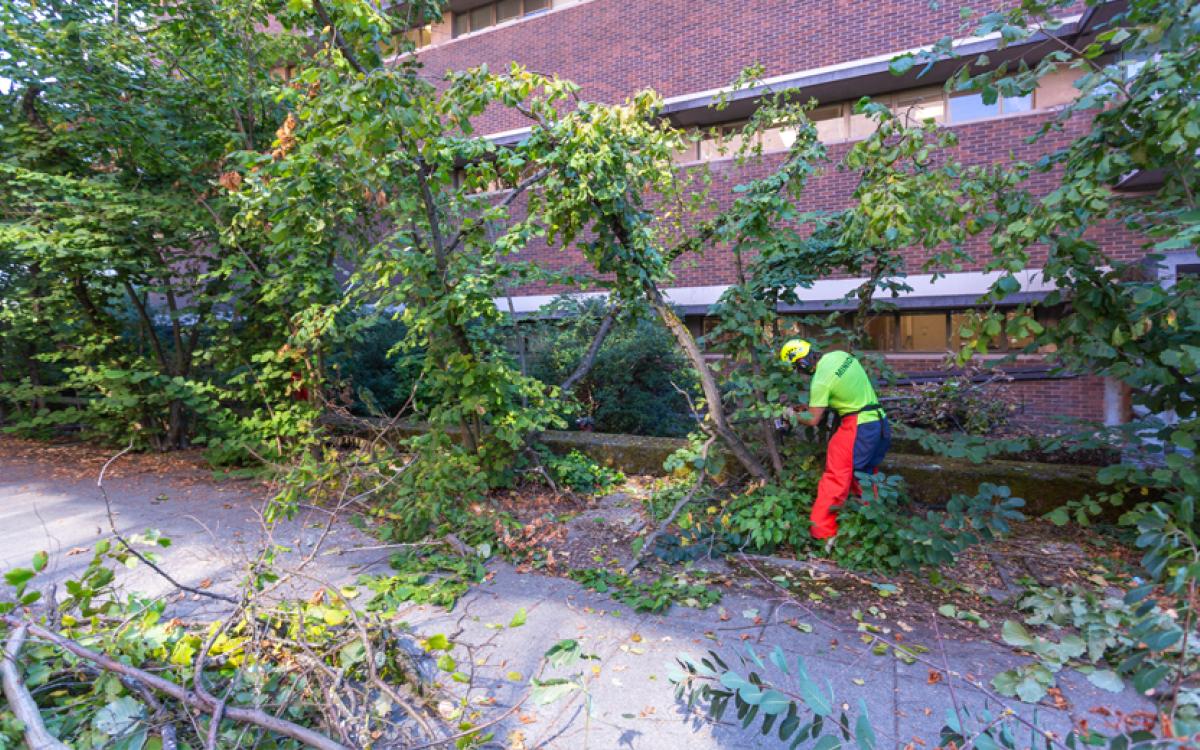
Gardener Ian Wyborsky uses a chainsaw to thin hazelnut trees near the Life Sciences Building, a task easier to do when there are fewer people using the pathways. Misty Shock Rule/University of Washington
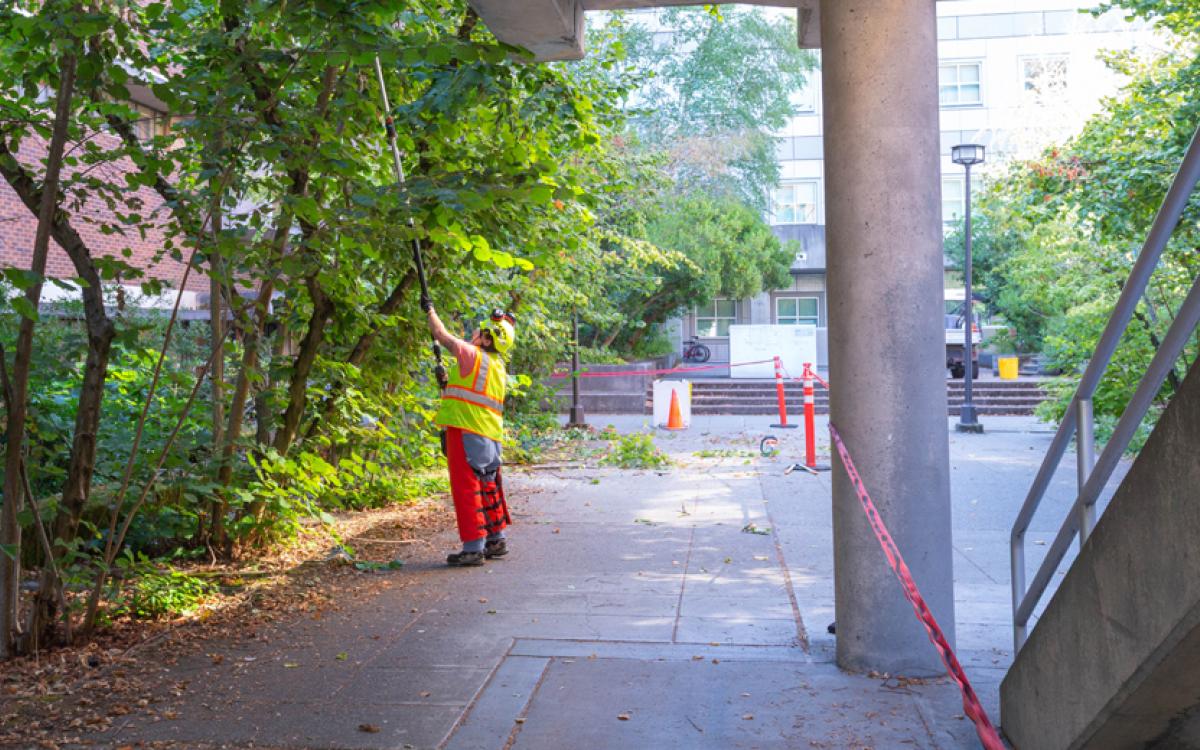
The breezeway is blocked off while Gardener Abigail Ellis thins the trees with her pole saw. Misty Shock Rule

Active Transportation Specialist Laura Beck shows off just a few dozen of the 600-plus keys she distributes to maintenance staff for bike locker cleaning. Brent Waller/University of Washington

A few of the 600-plus bike lockers that are individually cleaned over a five-week period each summer. Misty Shock Rule
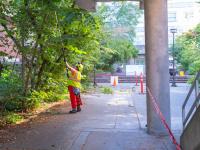


Every summer, Transportations Services maintenance crews also clean the 600-plus bike lockers on campus. They pressure-wash the exterior and sweep leaves and dirt out of the interior, tasks easier to do in warmer weather. It’s a big job that takes place over five weeks, as Huskies assigned to lockers are asked to vacate them for a week. Active Transportation Specialist Laura Beck manages the more than 600 keys that she hands out for each week’s cleaning.
“Having physical keys can be tough, especially when you're dealing with like 60 keys at a time,” she said. “You know, it’s critical to not lose any of them.”
She’s excited about two new keyless options for bike lockers. Bluetooth bike lockers, part of a pilot project, are accessible via an app to those renting them, while a few on-demand lockers, similar to those at Sound Transit stations, are accessible to anyone for 5 cents an hour.
Cooling people and a particle accelerator
Cooling people and a particle accelerator
On a hot day, a water fountain can be one of the most important spots in a building. They used to provide just a short drink, but now they can provide all-day hydration if there’s a spot to fill up water bottles.
A UW Facilities program is making sure that both can be done safely across campus. Staff are replacing older porcelain drinking fountains with modern fountains that include bottle-filling stations and integrated UV sanitization technology. They are also conducting water quality assessments and lead testing to identify potential concerns with existing fixtures.
The program is starting in the Art Building, Music Building and Thomson Hall. The team will then take what they’ve learned to develop a consistent approach across campus.
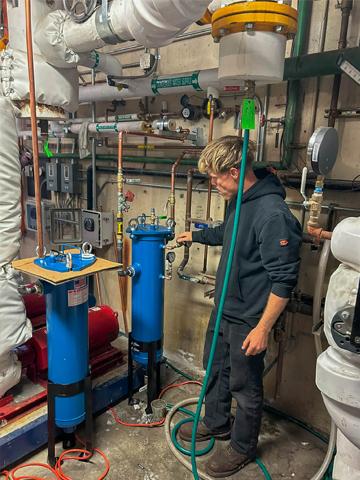
Pipefitter Kris Larson monitors condenser water conditions at the new side stream filtration unit he installed. The unit is used to flush, clean, and treat cooling water for the North Physics Laboratory's particle accelerator. Steve Snyder/University of Washington
Up the road, the North Physics Laboratory houses a particle accelerator that is used for collaborative international projects. It contains at least 30 water-cooled components. UW Facilities is taking over management of the cooling system, which was close to failure.
After initial stabilization, plumbers and pipefitters have been working to normalize maintenance for all cooling systems and establish proper water treatment.
“With differing loops, piping materials and system needs all combined together, performing this renovation and maintenance work has been like performing vascular surgery,” said Maintenance Manager Steve Snyder.
In the process, the team discovered a huge sustainability opportunity. They are now working on designs for a new heat exchanger that will redistribute loads, “saving a huge amount of water and energy,” he said.
This summer, UW Facilities’ Transportation Services department also made major repairs to the South Campus garage, which serves staff at UW Medical Center – Montlake and Health Sciences. The garage had experienced structural deterioration due to age and water intrusion.
“This project was a significant undertaking that touched every area of Transportation Services,” said Project Manager Jolie-Ann Tahara. Some customers were strategically relocated while one-third of the garage was closed in phases over the course of the three-month project.
“The level of coordination, adaptability, problem-solving, and collaboration was truly remarkable, ensuring a smooth transition and a successful outcome for the South Campus community,” she said.
The project is the first in a decade-long capital plan to address deferred maintenance in garages across campus.
Maintaining campus like it’s home
Maintaining campus like it’s home

Quintera uses the cleaning machine to dislodge dirt in a Mechanical Engineering classroom as Mebratu looks on. Misty Shock Rule/University of Washington
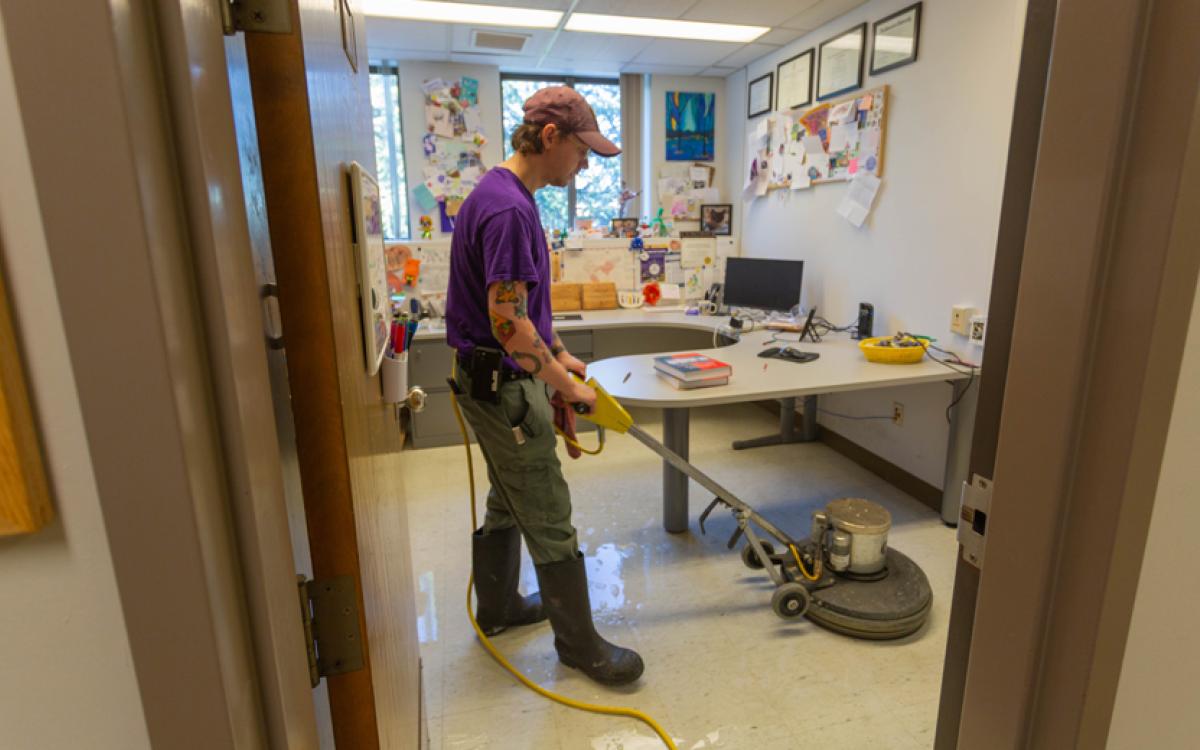
Custodian Matt Baldwin uses a machine to strip the wax off the floor of an office in Benson Hall. Misty Shock Rule/University of Washington
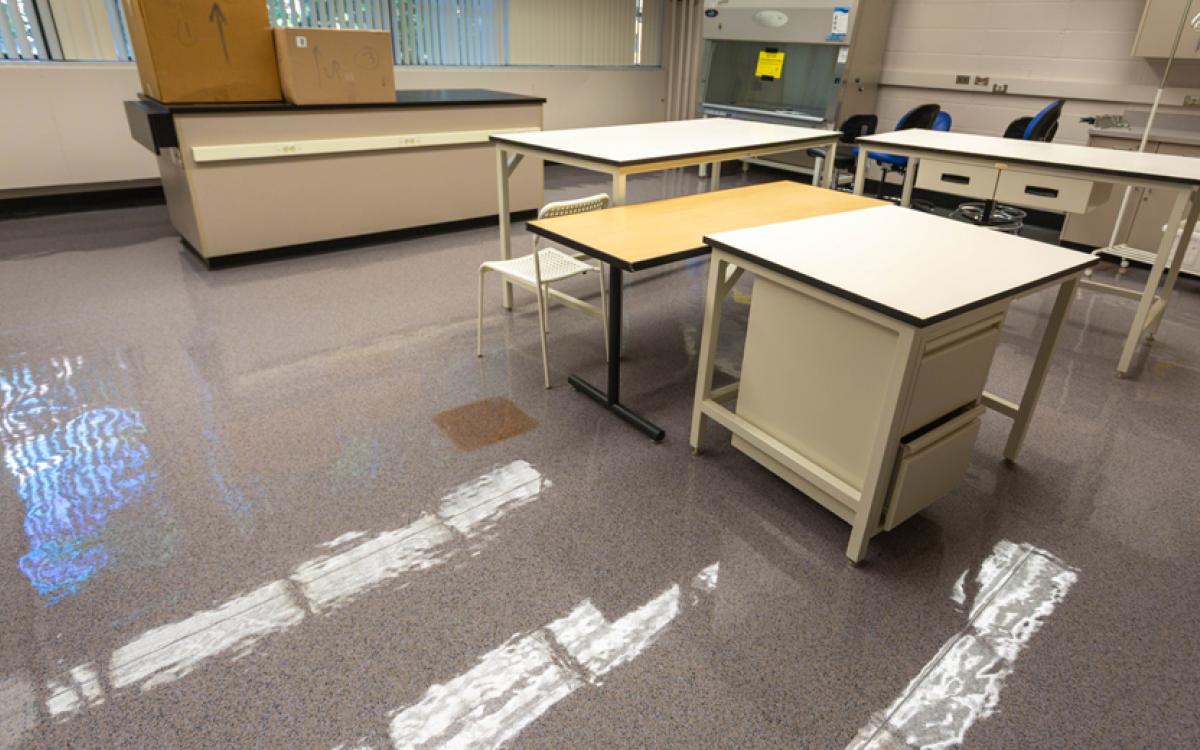
A lab floor that was recently stripped and waxed in the Mechanical Engineering Building. "It looks like glass. It's so pretty," said Building Coordinator Elizabeth Bell. Misty Shock Rule

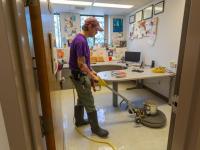

Back at the Mechanical Engineering Building, Quintero and Mebratu work in tandem to clean the classroom floor. Her machine squirts out cleaning solution while a floor pad spins and scrubs. His machine follows, using a squeegee to wipe everything into the machine’s tank. Later, the room will be waxed as well.
Meanwhile, department leaders conduct tests in buildings across campus to see how well the UW is meeting national cleaning standards.
One test involves doing spot checks and evaluating levels of cleanliness. With another one, a Q-tip-like swab is used to collect samples from places such as doorknobs or toilet seats. It’s then inserted into an ATP (adenosine triphosphate) device, which measures organic residue. Both tests are valuable for establishing benchmarks and goals for the UW's cleaning standards.
It’s been a busy summer. But for UW Facilities, it’s all in keeping with the feeling of care and responsibility they feel for the UW campus.
“I do my part. This is my building,” Mebratu says of Mechanical Engineering. “I have a boy, a little one. If I'm going to be sending that little one to school, I don't like to think he’s going to be sitting on a dirty floor, right?
“I'm going to look after this place like it’s my home. It's my second home.”